The Workhouse and Guardians Court
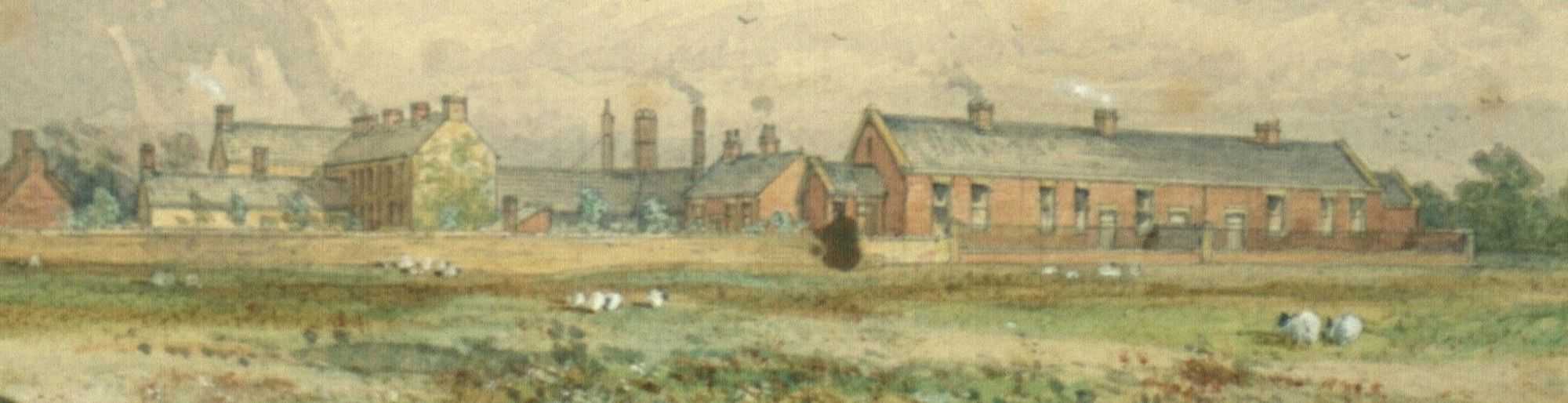
Today, all that remains of the Ponteland Workhouse is a couple of old walls and the name “Guardians Court”.
Workhouse — audio guide
The Guardians were the 79 elected Guardians on the Castle Ward Poor Law Union who, in the days before social security protections, were required to provide for the poor in the district, including building workhouses if necessary.
Workhouses were district-run facilities where destitute people could live in exchange for labour. These were made deliberately grim places to discourage people from seeking public assistance unless absolutely necessary. People had to apply for admission and once admitted, they gave up their freedom. They could not leave at will. Just after the workhouse opened at Ponteland, there is a record of one of the inmates absconding and being sent to prison for a month after being captured. Inmates all had to wear a uniform. Families were separated and segregated with the men, women, children and the elderly all living in different sections. Food was meant to be basic but there is some evidence that the meals provided were better than average here at Ponteland.
The workhouse was built on what was then the outside of the village on a greenfield site off North Road on land purchased from Matthew Bell of nearby Woolsington Hall. It was erected by the local builder John Donkin and it was designed to hold about 120 inmates when it was opened in 1849 and it was built out of bricks which were made on the site. The 1859 Ordnance Survey Map shows that it was the biggest complex of buildings in the village at that time.
Until the workhouse was extended in the 1880’s, the site was split into two halves much like today’s Guardian Court. Most of the workhouses buildings were on the northern half of the site with a large garden on the southern half with presumably the Workhouse Master’s house at the south-east corner.
There looks to have been an extensive rebuild in 1888 which included the provision of a new hospital wing. The site was enlarged to the north and east to cover all the land now occupied by Guardians Court and new blocks were added to the existing buildings.
In 1911 there were seven officials at the workhouse which would have included a master, matron, medical officer and a chaplain. These were responsible for the 96 inmates at that time. There is a wonderful snapshot of life at the workhouse in the early years of the 20th century provided by Arthur Halliday whose father was the Master and his mother the Matron of the workhouse from 1898 until 1928.
Social attitudes were beginning to change at that time and the poor were being treated less harshly. Arthur claimed his parents were appointed because the Board of Guardians wanted to shake up the management of the institution and his parents wanted to provide the inmates with more self-respect. Having said that, conditions could still be daunting. Men and women were still separated. Men were in dormitories of up to eight beds and women in rooms of four beds. At one time there were 42 children in the workhouse. Boys and girls were segregated and were kept until they were 14 then they were apprenticed out. It was often difficult to secure a position as not many people wanted a workhouse child.
It was a different story with illegitimate births. The building contained a maternity ward, and he recalls that there were quite a few births. Most were young unmarried girls who had got pregnant. This was then socially unacceptable and as there was no employment possibilities for a young mother, the options were very limited. Sometime, if the girl came from a large family, the baby would be passed-off as a late arrival and raised as the mother’s baby sister. Or where the family could not or would not help, then it meant the workhouse.
The workhouse had a part time doctor who would attend to check the child, and the nurse would assist with the birth. Arthur’s mother (who was a nurse) was also on hand. With illegitimate workhouse births, there was a list of people who were willing to adopt. The Relieving Officer would visit the house of any potential new parents to check their suitability. Arthur’s mother was often asked to accompany the officer. They had high standards and if the house was the least bit dirty, the baby would not be placed there. 95% of the babies in the Ponteland workhouse were eventually adopted.
In most accounts of workhouses, food seems to have been a major problem with residents kept on near starvation diets. Arthur claimed that many people were fed better in the workhouse than many on the outside. A pint of porridge was the usual breakfast and lunch consisted of soup and 8 ounces of bread. It wasn’t a thin soup but more like a broth containing pieces of meat. There was meat for dinner on alternate days and always a roast on a Sunday. There was always a pudding, often milk based such a rice or sago. This was largely because milk was cheap. Supper consisted of bread and butter. Cakes were made on the premises and often on the menu were rice cake and fruit cake.
One would expect Arthur’s recollections to be prejudiced given his parents and the time that had elapsed however there is documentary evidence in the form of newspaper accounts which would seem to back up his claims. It does seem that the residents in Ponteland were better treated than was generally the case.
The last Christmas Dinner of Roast Beef and Plum Pudding which had become something of a tradition in the workhouse was held in December 1928.
Workhouses fell out of favour during the 1930’s and the emphasis shifted away from repression to more of support. The workhouse was renamed the Poor Law Institution looking after the old, the sick and the incapable. The Guardians were retired and it came under the control of the County Council’s Public Assistance Committee. With the outbreak of the Second World War it became an emergency hospital for convalescent soldiers, TB patients, some evacuees and later post-operative patients from Newcastle General Hospital. When the National Health Service came into being in 1948 it continued as the Ponteland Hospital, run by the Newcastle Authorities, and nursing elderly patients mainly from the west end of Newcastle. It continued in this role until 1992 when it was closed down by Newcastle Health Authority. On its closure its 50 geriatric patients were moved to two private nursing homes in Newcastle.
There were plans for a small residential home with nursing care on the site but these could not be funded. Instead, the land was acquired by the building firm Cussins. They made a contribution to Castle Morpeth Council towards improved community facilities in Ponteland and the council approved their plans for new houses to be built on the site
The developers wanted to name the new houses Naworth Court but the Parish Council fought hard to have its heritage recognised in the name and the developers eventually relented and it is named Guardians Court.