Woodside and the Remaking of Darras Hall
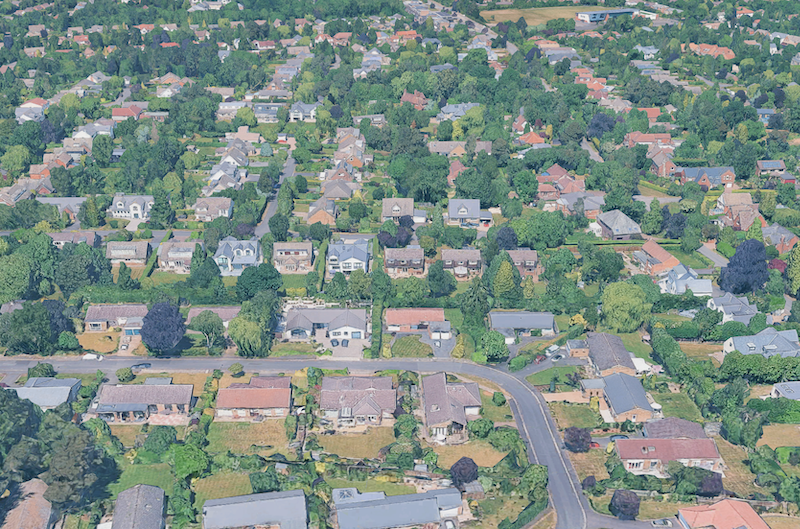
The Darras Hall we know today was created in the 1960’s when what had been an estate of small houses on large plots of land started to become an estate of large houses on small plots of land. Instrumental in this change was Barratt the builders, whose role in this has been overlooked as the company was then known as Greensitt Bros. Ltd.
Woodside — audio guide
To understand the process behind this we have to go back to 1910. The Northern Allotment Society (despite its name) had evolved into a self-help society to aid Tyneside business men to escape the dirt and insanitary conditions of the town and to build a family home in the countryside. To do this, they acquired agricultural land and split the fields into building plots and provided the necessary infrastructure such as roads, water supply and sewerage. Each plot was generally 5 acres.
Progress was slow. Two World Wars and economic depression did not help but one of the factors slowing development was that business men lacked the expertise and time to deal with the administration and organisation involved in building a house. An exception was Lawrie Barratt, a Chartered Accountant from Newcastle. He built his own house on the estate in the 1950’s and soon followed it with two others which he sold.
He spotted the development potential of the estate where up until then, what building had taken place was just along the frontages of the main roads crossing the estate, leaving vast areas behind the roadside frontages. He teamed up with a local builder called Lewis Greensitt and founded Greensitt Bros. Ltd. in 1958 to provide ready-built quality houses.
One of their first projects was a new shopping centre just next to the estate which would become Merton Way. As this was underway, they were planning a similar shopping centre in the middle of Darras Hall which they saw was essential if the estate was to progress. This became Broadway.
The company realised that Newcastle was re-emerging as a commercial centre out of which was developing a new middle-class, who having their own cars, were not restricted to living within the city. These were the people who could afford the mortgage on a nice, new house and they targeted this market. Darras Hall with its transport links, strict planning regulations and proximity to attractive Ponteland was ideally placed for this. Parallel to building Broadway they developed two “estates” close to the new shops, these were Parklands and Woodside.
The five-acre plots were sub-divided and side roads laid to provide access. There was an interesting article published in the Evening Chronicle in 1963 describing the houses being built, headed “Luxury on two estates”.
“On the Woodside Estate bungalows, houses and Dutch bungalows are built on sites of a quarter of an acre upwards. The dwellings are built to a variety of designs and provide two or three reception rooms, three to five bedrooms and may have double garages.
Well-appointed kitchens and extensive fittings throughout give the key to gracious living on one of North East’s most attractive estates. All the houses are conveniently placed for the new shopping centre and all have full central heating and domestic water supplied by high speed gas.
Prices range from £6,250 to £6,950.
Many of the houses built at this time still survive but most have been substantially altered or extended to keep them up-to-date. Increasingly, as houses are being put back on the market, if they occupy one of the more prestigious main roadside plots, these are being redeveloped as mansion houses reflecting the social cache now attached to living at Darras Hall.
As for Greensitt Bros., they went on from strength-to-strength. By 1968 they floated on the London Stock Exchange as Greensitt and Barratt. At that time, they were building around 500 homes a year. In 1973 they changed their name to Barratt Developments and became a national building concern completing about 10,000 houses per year.
In 1983 they sold a record 16,500 homes making them the largest UK housebuilder. Now known as Barratt Redrow they are still one of the UK’s largest, completing around 20,000 houses a year.