St Matthew's, a Modern Church
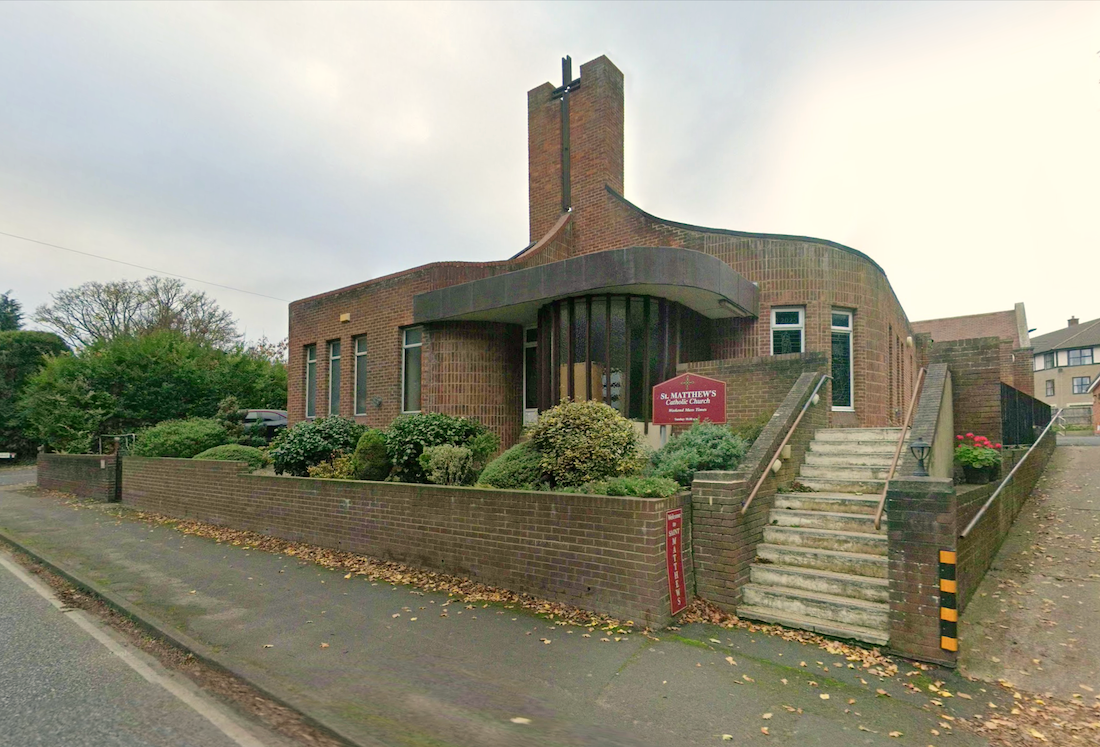
There is a striking modern church on West Road in Ponteland. This is St Matthew’s Roman Catholic Church and the parts of the building visible from the road date from 1978. The curved brick walls sweeping up to meet a narrow brick tower containing a large recessed metal cross combined with the curved glass of what used to be an entrance porch projecting from the front make a pleasing façade facing the road.
St Matthews RC Church — audio guide
After the protestant persecution of Catholics following the Reformation, only a few pockets of the faith survived in this part of Northumberland sheltered by a few gentry families that still clung on to it. One of these was the Riddell family of Cheeseburn Grange in Stamfordham who retained a priest.
Towards the end of the 18th century, the restriction on Catholics started to be lifted and following the potato famines in Ireland and the expansion of coal mining in the area, there was a large influx of Irish immigrants who brought their Roman Catholic faith with them. In the later part of the 19th century the priest retained by the Riddells at Cheeseburn would travel to celebrate Mass in a rented cottage in the West End of the village and in a cottage next to Neasham House.
The first purpose-built church on this site was little more than a wooden shed. It was opened in 1903 and dedicated to St Matthew. In 1947, the then chaplain, Father Doyle, gave up his residency at Cheeseburn and moved permanently to Ponteland and began to plan for a new church. In the intervening period before the new church was completed, services were held in Smith’s Café, a popular cycling venue which stood opposite this site.
The new church which opened in 1950 was a big improvement on the shed which was retained and used as a chicken-coop by the priest’s housekeeper. It was still however relatively modest and forms the rear of the current building. The Presbytery adjoining the church, where the priest lives, was also built at this time.
The shed survived until 1992 when it was demolished to make way for a new Parish Hall which was erected on the site.