Ponteland's Short-Lived Railway Station
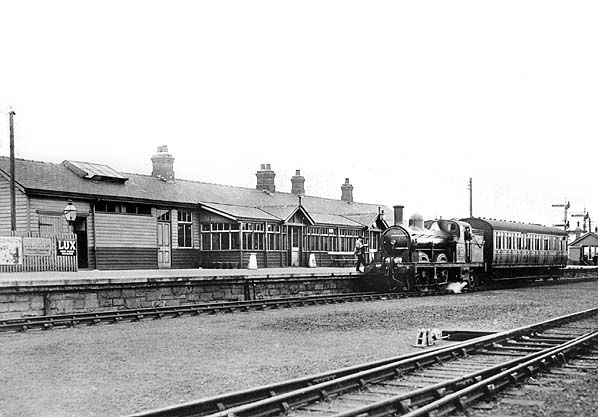
Ponteland had its own passenger railway station for 24 years at the beginning of the 20th century. Although it had a relatively short life as a passenger station, it did have some very prestigious visitors over the years as the sidings were where the Royal Train was parked overnight when members of the Royal Family visited the region. Events such as the opening of the Tyne Bridge in 1928 and the North East Coast Exhibition the following year brought King George V and Queen Mary here. During the Second World War Churchill arrived in his special train here along with his Chiefs of Staff.
Railway station — audio guide
Unlike its rural neighbours, the line was not closed by Beeching but the closure was caused by the introduction of busses in the 1920’s. Although it no longer carried any passenger traffic, the line and the station continued to be used for handling freight right up to 1968 when it was completely closed down and the station and the extensive sidings which dominated the western side of Ponteland were cleared and the land subsequently redeveloped as the Meadowfield Estate. The linking of Ponteland to the rail network had a pivotal effect on Ponteland’s development transforming it from a rural backwater into a major dormitory town. It all began with two Acts of Parliament.
By the end of the 19th century, the railway industry was heavily regulated which made it prohibitively expensive to lay any new tracks and open up new stations. In 1896 parliament passed the Light Railways Act allowing the railway companies to build railways carrying smaller trains which meant tracks could be narrower and cheaper to both build and run. The North Eastern Railway Company took advantage of this to apply to open a new branch line connecting Gosforth with Ponteland. The Bill which allowed them to do this was the Gosforth and Ponteland Light Railway Act granted in 1898. The estimated cost of the total project was £33,000 which was the equivalent of laying only one mile of conventional track.
The promotors of the line hoped to replicate what was happening in the suburbs of the South of England, where the opening up of a railway line had a dramatic impact on land prices and led directly to the establishment of new estates and communities with professional people taking advantage of the new links to leave what were then very dirty and insanitary city centre to move into the fresh air of villages such as Ponteland. Even before the Act was passed, local landowners started to cash-in, releasing previously agricultural land as building plots.
The station built at Ponteland was a relatively modest timber building reached up a narrow lane from the base of the new railway bridge that had been built over Main Street, roughly where the footpath past Merton Hall now is. It was a long, single-storey, thin building running along the eastern platform with a glazed verandah stretching about two-thirds of its length, decorated with two cross-gables.
The seven-mile-long line opened for passenger traffic on 1st June 1905. The station buildings were bedecked with flags and bunting and the whole village of Ponteland appeared to be on the platform to greet the first train as it arrived in the station. Several fish-women had taken advantage of the new link and had made their way from Whitley Bay that morning to bring very fresh sea-fish to the village for the first time. “There was an air of rejoicing in the place, as though people felt that it was a red-letter day in their lives”.
The railway proved very popular at first. In 1911 there were 32,084 tickets issued. The widespread introduction of motor busses after the end of the First World War would prove fatal to it however. These were provided between Ponteland and Newcastle in 1921 and soon were taken over by Newcastle Corporation. These were much cheaper and more frequent and more flexible than the railway, picking up and dropping off passengers almost from their font door’s. In the face of this competition, the railway company withdrew from passenger services in 1929.
Freight traffic along the line still remained popular. Ponteland had a very large goods yard sited on the western side of the station. Facilities in the 1920’s included five sidings and a reversion loop, water tower, cattle dock and a large brick goods shed. It was not until 1967 that the goods service was discontinued.
In the 1970’s, the land was redeveloped as part of the Meadowfield Trading Estate.