The Prisoner of War Camp at Darras Hall
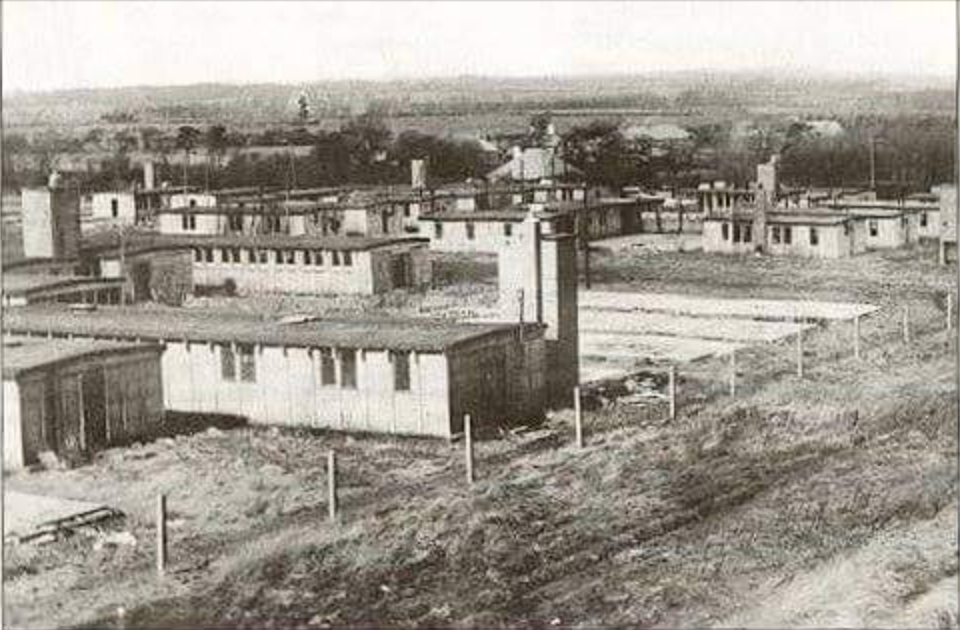
A surprising feature of the Darras Hall Estate is that it was the site of a Prisoner of War Camp during and after the Second World War. This was strongly opposed by the Estate Committee at the time as it broke every by-law and regulation governing the estate but the needs of War took priority and the camp was approved in April 1942.
POW Camp — audio guide
At that time, Darras Hall was still mainly empty but had good roads and cleared ground making it an ideal site for a camp. There was plenty for the prisoners to do. The area around Ponteland was still mainly agricultural and with most of the young men away fighting, the farms were crying out for workers.
The camp was established on four of the vacant building lots on Darras Hall just to the south of Middle Drive, between it and The Rise, on sloping land now mainly occupied by Parklands. It was almost seventeen acres.
The first Italian Prisoners of War started arriving at the camp in 1943. They were billeted in three rows of huts. Each hut had 20 beds running down either side and housed 40 prisoners. At its peak in 1945 there was a total 830 prisoners held at the camp. Security does not appear to have been very strict but the prisoners were identified by a yellow patch on the back of their uniform jacket and a further similar patch on the back of one trouser leg. They were transported daily from Ponteland to work on local farms and market gardens and generally got on well with the local population. From March 1945 onwards, German prisoners started to arrive, the first coming by bus from Newcastle Central Station.
At this stage of the conflict, the German military were conscripting boys in an effort to fight to the bitter end and the prisoners were getting younger. One of them Rudi Lux was only sixteen years old when he was here and has told his story in a book called “From Pomerania to Ponteland”. He had only been in the army for six weeks when captured in May 1945 by the Americans. He was still held captive a year later when he was transported to England to work in the fields on farms around Stannington and Meldon. His old home in Germany was now in the Soviet controlled zone of East Germany and his father wrote to him saying how bad the conditions were at home and if he got the chance, to stay in England. This arose in 1948 when he was due to be released. The UK government wanted 40,000 ex-POW’s to stay behind to work to help ease a chronic labour shortage. Rudi was one of those who took advantage of this. He left the camp and moved to Widdrington where he started work at Stobswood Brickworks.
the end of 1949 the last of the prisoners had either returned home or been transferred elsewhere. In 1950 most of the accommodation was demolished and from 1951 the site was used as a Training Centre for Civil Defence. During the Cold War the government set up camps across the UK to train Civil Defence personnel in such things as rescue techniques, dealing with gas attacks, bomb damage, fire-fighting, in case another war broke out.
The site was cleared by July 1961 after it was acquired by Greensitt Bros. Ltd, the company which eventually evolved into Barratt’s the building company. The used it for their Parkland’s development on the Estate.