Little Callerton Farm Among the Mansions
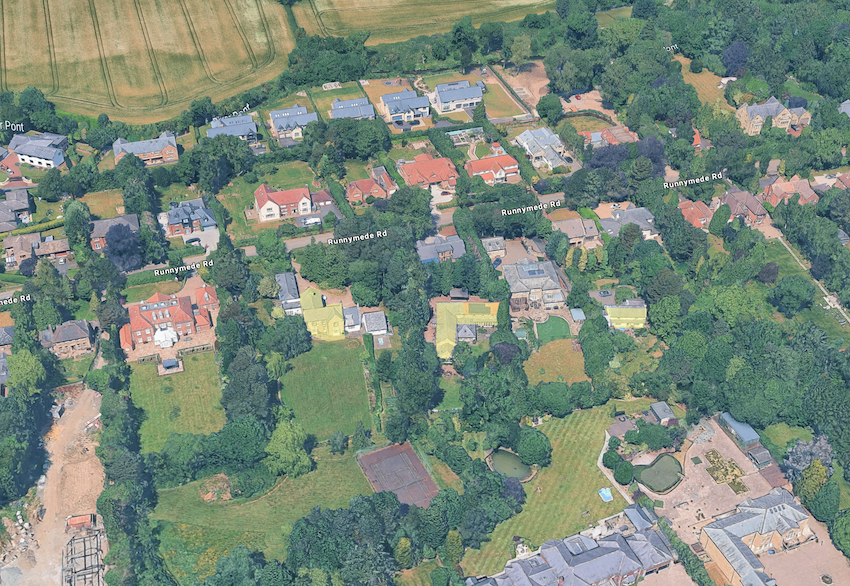
Nestled amongst the mega-mansions of the modern Darras Hall is a rare reminder of its agricultural past. Although they are much adapted, these three buildings are the remains of what was once Little Callerton farmstead, part of the Medieval township of Callerton.
Little Callerton Farm — audio guide
Callerton is mentioned in documents dating back to the 13th century. Little Callerton and High Callerton were known as Callerton Valance after the family that held the land. High Callerton was called that because it stood on a rise of land and Little or Low Callerton got its name as it was lower down. Callerton itself means “hill of the calves”.
The rents paid by the tenants of Little Callerton went to support the priest at Morpeth and after the Reformation under Edward VI, helped fund Morpeth Grammar School.
L. Callerton is marked on Armstrongs’s map of 1769 indicating two buildings present and it is also shown on Greenwood’s Map of 1828. The first detail of the farm is shown of the Ordnance Survey Map of 1860 which shows precursors of the three groups of buildings. By the next Ordnance Survey Map of 1895, the origins of the three houses indicated in the photograph can be seen.
The differences between the two Ordnance Survey Maps are revealing. It appears on the earlier map that what is now Little Callerton Cottage was the original farmhouse as the paths led to it and it had a garden. There were two ranges of outbuildings to the west of the farmhouse, one of which must have been a barn as it had a gin-gang attached to it for threshing corn. The range furthest west is long and narrow. By the end of the 19th century, the western range has been demolished and a new building built. This was probably a new farmhouse. There is some indication that this was built in 1873 as there was a notice published then advertising the farm to let which indicated that a new farmhouse would be built to “make it a suitable residence for such a farm”. This later became No. 87 Runnymede Road.
It was probably then that the old farmhouse was split into two and used as workmen’s cottages. This later became 79 Runnymede Road or Little Callerton Cottage.
The middle building had been extended with a western range to form a south facing courtyard and the gin-gang is no longer in use. It was this western extension which looks to form the basis of No. 83 Runnymede Road.
I mentioned earlier that the farm had a gin-gang. A gin-gang was a circular shed which housed a horse-powered engine. The horse walked around turning central driveshaft which drove a threshing machine. This early form of mechanisation was very common in this part of Northumberland where the farms had to compete with the pits for manpower. Many of the circular buildings now are features of old farms which have been converted into houses or pubs and restaurants. By the 1895 map, the gin-gang was no longer in use here. The reason for this is that it had been replaced by a water-powered threshing mill. The farm stood above a bank leading down to the River Pont. The mill was not powered by the river but rather from a pond dug out just down the lane from the farm. This was fitted with a sluice gate allowing the water to flow down and drive the mill.
Like most farms in the area, this was a tenanted farm, owned by a local landowner and rented to professional farmers. It was bought by the Silvertop family in 1774 and was acquired by George Dunn in 1809 before being bought by the consortium which developed the Darras Hall Estate in 1907.
Notable tenants were John Lenox, who was the first tenant to appear in the 1841 census when he fifty years old and was described as a farmer of 355 acres. He was known for breeding premium bulls. During the 1870’s the farm was occupied by Cuthbert Handyside who lived here with his wife, son and two servants. The last recorded tenant was J. Sutherland. When he sold up in 1906 the farm was described as an “Excellent Farm”.
For much of its existence, the farm was worked together with the neighbouring farm of Callerton Moor. It was the lands of these two farms plus Darras Hall which lay to the south which were put on the market in 1907 and bought by the Northern Allotments Society.
After the 1907 sale to the Northern Allotments Society, the farmland was broken up into plots of around 5 acres each. One of the main roads of the new planned estate, Runnymede Road was laid just behind the buildings and the land on which the farmbuildings stood was divided into two lots which were then offered for sale when they would have been adapted into modern residences.
A big change came in 1998 when the eastern side of the old farmyard which had formed No. 81 Runnymede Road looks to have been demolished and a modern house erected on the plot.