Ponteland Golf Club, Established 1927
Ponteland has one of the most popular golf clubs in the North East of England.
Golf Club — audio guide
It was founded by William Nunn, a civil servant who lived in Darras Hall and later went on to be an M.P. and his friend, F. P. Bell, the local Barclays Bank Manager. They organised a meeting of professional and business people in the Ponteland Memorial Hall on February 16th 1927, when it was agreed to start a golf club in the village.
They had three possible sites for the new club under consideration; one on the Darras Hall Estate itself, another at Berwick Hill and the third here at Eland Hall which was the one they eventually chose. It was very accessible (particularly from Newcastle where the new club hoped to attract many members). The ground was also very suitable being light and sandy, with every prospect of the greens being kept in good condition.
From the outset, it was decided to form a limited company The Ponteland Golf Club Limited which was incorporated on the 12th August 1927. This enabled them to borrow the money to finance the club.
One hundred acres of land were leased from Mr. Meek of Eland Hall Farm on a 20 year lease at £250 per annum with an option to purchase the freehold at any time during the term for £6,500.
A nine-hole course was laid out under the guidance of Northumberland professional Harry Fernie from Gosforth Park, employing six local men to lay out the greens and fairways. They advertised in April for a greenkeeper/steward and George Snowdon was appointed.
*Snowdon is a young man who has given a good account of himself as a player, and he is a clubmaker of repute. He commenced his apprenticeship with J.B. Lawson, when the latter was professional to the Wearside Golf Club, and on being discharged from the army in 1917 he finished his training as a golf professional under the late J. Douglas Edgar before the latter left Northumberland Club to go to America”.
By July 1927 they already had a playable nine-hole course. The club purchased a new Atco motor mower and could rent a horsedrawn reaper from the farm when required.
The course was formally opened in early 1928 by Viscount Ridley and the members paid a three-guinea annual subscription. This was the equivalent of a week’s wages for a skilled worker. It was deliberately pitched to attract the middle or upper middle classes, affordable but exclusive to them. Ladies and junior members paid half this amount. It is worth observing that the club had almost as many female members as males. At a time when most physical activity for women was restricted (social norms discouraged running, sweating, or competitive behaviour), golf offered a socially acceptable way to be active outdoors.
The members had the use of a temporary 60-foot-long wooden hut as a club room.
Between 1928-31 more land was leased and on May 2nd 1931 the new 18 hole course was opened by Lord Kirkley.
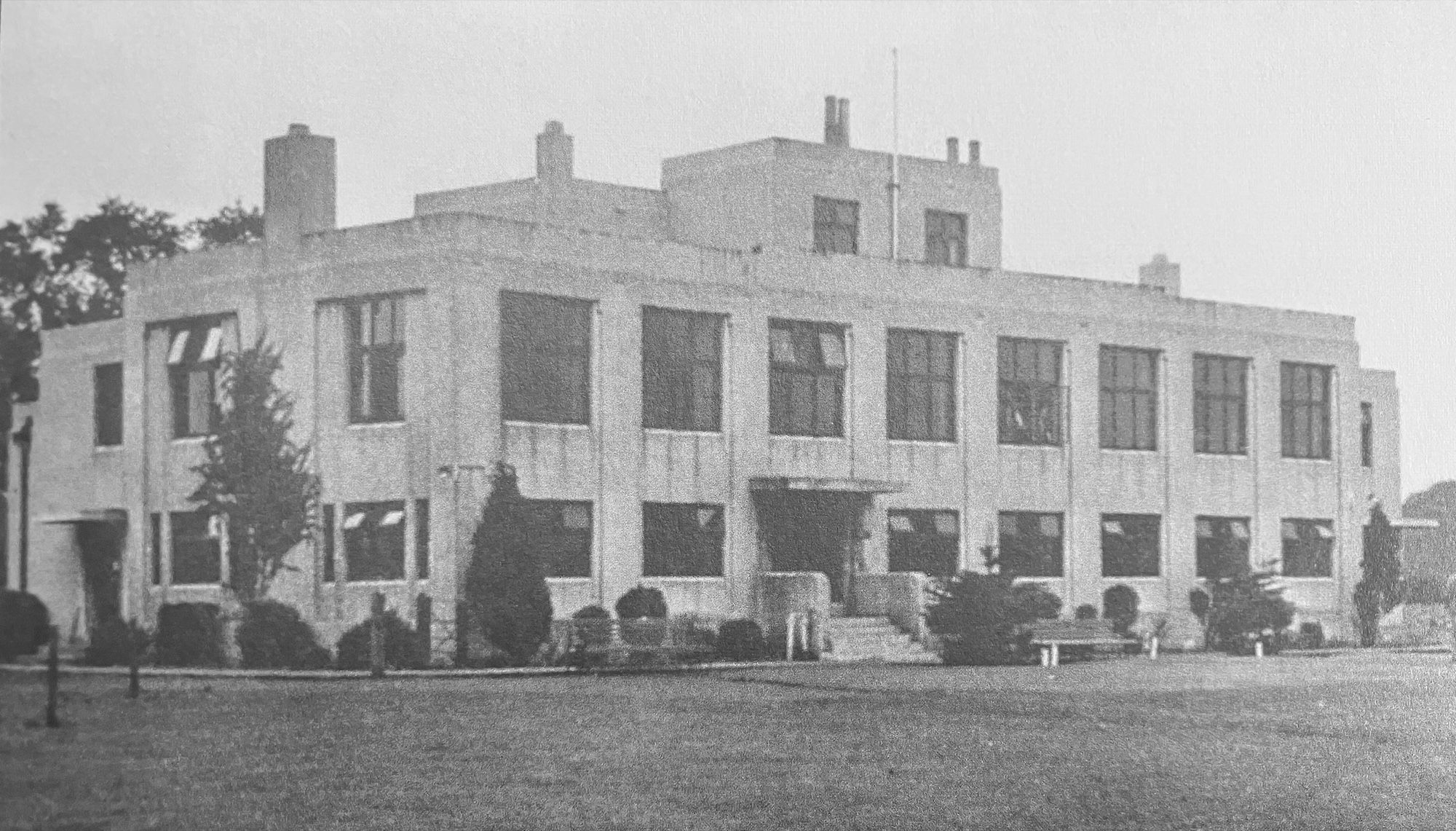
The temporary club house was replaced by a rather fine permanent one in 1937 built at a cost of £4,000.
The Second World War had a catastrophic effect on local sport but golf, which was not reliant on teams or badly hit by travel restrictions, was relatively unscathed and golf continued throughout the war, albeit on a limited scale.
The freehold of the course was purchased shortly after the end of the war in 1947 and the clubhouse was extended at various times including 1983 when a caddy car shed, tractor shed and workshops were added. This was carried out as part of a deal with builders Bellway in exchange for the club giving up part of its land as access to Bellways new estate. Unfortunately all the changes to the club house over the years have not been kind it and the original striking building has lost all of its architectural integrity.
There was a big change to the course around the mid 1960’s when trees were planted providing a small wood, which breaks up the middle of the course, as well as small copses to better define the fairways, giving the course its modern appearance.
An automatic watering system was laid to each green in 1980 to cope with any drought.