From Cottage Homes to Jameson Manor
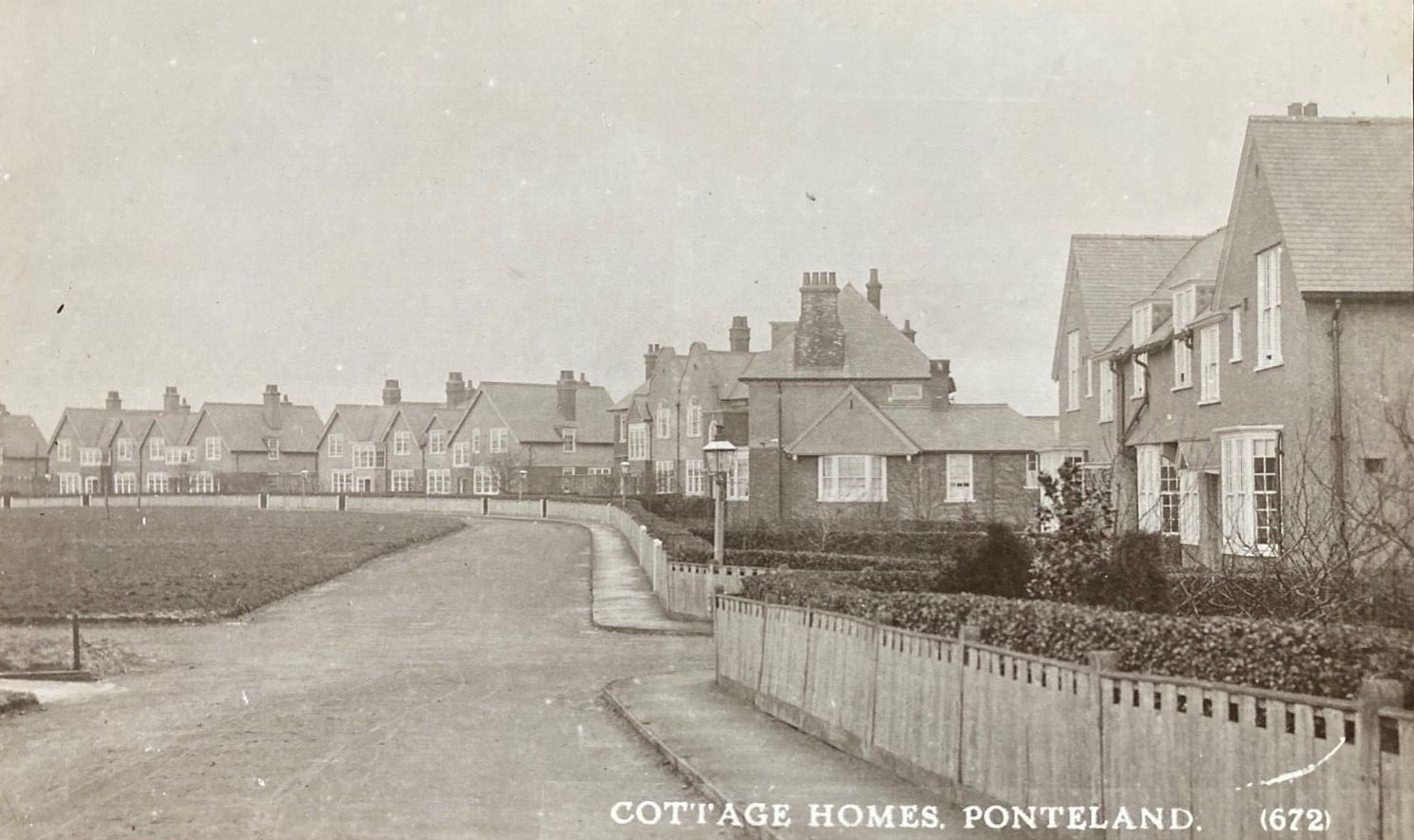
Jameson Manor is a new housing development just outside of Ponteland heading north, which sympathetically incorporates some Grade II listed buildings which formed part of the Ponteland Cottage Children’s Homes and later used as a police training centre. The site has a fascinating history going back to 1903.
Cottage Homes — audio guide
Formerly, the only option for the care of destitute children had been the workhouse. Ponteland had its own workhouse down the road from here which had around forty children amongst its inmates. Towards the end of the 19th century, a more humane approach began to be adopted. This was pioneered by charities such as Barnado’s and the National Children’s Homes but soon Local Authorities were mirroring their approach. They moved away from large, impersonal institutions like workhouses and started to provide a more family-like and nurturing environment.
Instead of housing large numbers of children in a single building, they began to create clusters of houses which the children could live in, arranged like a small village – these were known as Cottage Homes. One of the first was in Sunderland in 1873. This one in Ponteland was created by the Newcastle Board of Guardians.
Before the introduction of the Welfare State, poor relief was controlled at a local level by Boards of Guardians. These were elected officials. The Newcastle Board of Guardians purchased a site of 70 acres at Ponteland between the Kirkley and Belsay roads. The Board worked with leading Newcastle architects Oliver, Leeson and Wood to design the homes. The brief was to avoid any suggestion of a “charitable institution” but to give the Homes the character of a village.
They created six blocks of semi-detached houses (called cottages), placed on the north side of a village green, providing all with a sunny, southern aspect. Each of the blocks consisted of two separate houses looking almost identical to the Edwardian style suburban houses which were being erected at that time along the main roads leading out of the towns and cities in England, with Dutch gables, steeply pitched roofs, large chimney stacks, bay windows and small front gardens lined with privet hedges. Each cottage block was designed slightly differently to make it easier for new children to find their own block.
Inside on the ground floor was a kitchen, day room, bathroom, lavatory, scullery, larder, pantry and store. On the first floor, two large bedrooms, each containing a number of beds, foster parent’s bedroom, and a small room for one bed and a linen closet. One block was slightly larger than the others accommodating twenty children in each of the two houses. The total was 190 children.
Each block had its own external washhouse with the older girls being given the responsibility for carrying out the washing under the supervision of the foster mother.
The superintendent’s house was placed near the beginning of the village and was equipped with a committee room for the use of the Guardians on their visits. There were an office and store rooms and a workshop block. This was equipped with three shops; a shoemaker’s, a joiner’s and a plumber’s where the boys could practice for a trade. There was also a large meeting hall and a gardener’s cottage/entrance lodge.
In 1903, cars were still only for the very rich, so stables were provided with three stalls, harness room and hay loft and coach house. This was also before mains water, so the water was supplied from a bore hole and pumped up by a windmill to a tank in a Water Tower.
There are some first-hand accounts of life at the homes.
Isabella Gardner was nine years old when she went to live at the Homes before the First World War.
She lived in cottage number six and her house mother was called Miss Swallow. Isabella enjoyed living there and found Miss Swallow to be a lovely lady who she always called mother. Isabella and her sibling were taken to the home after the death of their biological mother. Isabella’s father suffered from paralysis so was unable to look after his children. He was placed in the Ponteland Workhouse and once a month they were taken to visit him. He died in the workhouse six years after the death of his wife.
Isabella recalled that nearly every cottage had a pet cat. The Master and Matron had a couple of dogs and some of the ‘house mothers’ also had dogs which made it all feel very homely. The food was good, and she felt very well fed. They would have liver, sausages and tripe and they always had a roast on a Sunday. They grew all their own vegetables and baked their own bread, cakes, tarts and scones. They would pick fruit in the summer holidays and make their own jam.
In the early days, the clothes of the children were very severe. The boys wore grey suits and rubber collars on their shirts. Their hair was cropped very close. All the clothes were made at the Homes by the sewing lady, Later, things became more relaxed and the children had bought clothes.
All the children had chores to do. The floors in the cottage were white wood and the children had to scrub them. This was usually done at night. The children got up about 6am and were woken by a boy blowing a bugle. They walked to school then returned to the cottage for lunch then walked back to school again for afternoon lessons. They had leisure time though and the boys played football while the girls played hockey. There were swings in the grounds and a huge field to play in. Isabella also fondly remembered that the home had a horse and trap which the gardener used to drive.
Isabella once won first prize for baking bread. She recalls that one Christmas the Lord Mayor came to visit so the Master asked him to dress up in his robes as a treat for the children. He asked them to show him examples of their work so she showed him the bread and won a prize. Unfortunately, she didn’t say what the prize was but seemed very proud of her achievement. It would have been an extra bonus at Christmas time along with the shilling that each child was given on Christmas Day.
The children occasionally went on seaside trips to Whitley Bay with the chapel they attended. All the ‘mothers’ from the cottages would have large hampers & they made pies and cakes so they could have a nice picnic.
A boy called Billy did not have such an enjoyable time as a child but went on to become a house parent. Billy went into the homes aged 13 and boarded there while he learned his trade as a Shoemaker. All shoes were made on site. The only time shoes were bought were for the girls who went into service. He didn’t enjoy his time there as a boy and thought that the staff were cruel. Despite this, he eventually ended up working there making and repairing shoes. He said he worked hard as there were about 300 children and each child had two pairs of shoes or boots so he was always busy. He would often show the young boys how to make shoes, boots and clogs. Billy wanted to make a difference and give the children more attention and support. Along with his wife, he became a house parent and, on a Sunday, he would take them out for walks and picnics and let them enjoy themselves. The children had tea around 4.30-5pm and while he worked there, no food was given after this time. Billy didn’t want them to go hungry, so he introduced supper and gave them bread and butter.
The level of compassion shown seems to have depended very much on the individual characters of the house parents. One lady called Josephine had very fond memories of Ponteland. She first went there aged two with her older brother George and younger sister Dolly. Josephine loved Mrs Young who was her house mother and she thoroughly enjoyed living with her. There were about 20 children in the house and when she was small, she thought that Mrs Young had given birth to them all. Josephine claimed that her house was lucky as not all the house mothers were kind, and she knew that one used to hit the children on the legs with sticks. If the children were going to have visitors, she would ensure that the girls wore thick tights, and the boys wore long thick socks to hide any bruises.
It was partly the result of such stories of emotional deprivation and lack of affection that there was a landmark investigation into childcare services in 1946 called the Curtis Report. That recommended major reforms that led to the gradual closure of Cottage Homes.
During the 1950’s Newcastle Corporation followed the new guidelines and started placing deprived children with foster parents in their own homes or placing them in small “scattered homes” on new housing estates which they were building. By the end of the decade the Ponteland Homes were almost empty with only eleven children and were closed down. There was some discussion about handing them over to charity and their being converted into a Leonard Cheshire Home but in 1960 it was announced that they had been sold to Northumberland County Council to be converted into a teachers’ training college.
The 1944 Education Act expanded secondary education. That combined with the post-war baby boom meant that by the end of the 1950’s, there was a massive need for new teachers. Education authorities had to open up new teacher training colleges all over the country.
The buildings were renovated at a cost of £38,000. The initial group of 38 students moved in on October 1962. At first the students were housed in the old semi-detached buildings but these were gradually replaced with new halls of residence built in 5 blocks on the other side of the green.
The 1960’s and 70’s were not as liberated (at least not in the North East) as the popular imagination remembers they were now. There was strict segregation of the sexes in the halls of residence: No building, let alone floor of a building, was mixed-sex; students were not allowed to walk on the green and many lecturers treated the students like primary school children in their teaching; and resident students were not allowed visitors in their rooms after 11 o’clock at night.
Many of the students however came from traditional working-class backgrounds and although this was not a university it provided a similar experience an escape and a freedom that young men and women, fresh out of school themselves had seldom experienced.
At its peak, the college had over 1,000 students and as the 1970’s progressed, restrictions were eased and most the attendees remember their time there with a lot of affection. The college is even reputed to have hosted some famous bands such as Genesis, Amen Corner, Marmalade and Hot Chocolate playing in the Student’s Union.
As the “baby-boom” children gradually got older and left education, pupil numbers shrank and from the mid 1970’s further education colleges started to close or be merged with polytechnics or universities.
As the college was winding down, there was a lot of discussion on what should become of the campus. The 1980’s was the decade that Margaret Thatcher was in power and Local Authorities were under increasing pressure to control their costs. Northumbria Police was formed in 1974 by merging Northumberland Constabulary with part of Durham Constabulary but its administration was split between Morpeth and Ashington.
As the Teacher Training College was vacating, there were proposals for the County Council to sell the college and its grounds to the Police Authority to centralise their operations, as the County Council desperately needed more funds to finance its own move into new headquarters they were building at Morpeth. The Police Authority could not raise the asking price of £2.5m however. Discussions continued for a few years until the Home Office finally agreed to provide the money in the 1981-82 financial year. The college was formally handed over to the police on 1st September 1981 and the new Police Headquarters were opened by the late Queen in November that year.
One of the first new projects was the installation of a new telephone exchange system merging all the previous switchboards at Morpeth, Ashington, Ponteland, Blyth and Cramlington. This was housed in a large, modern communications centre and command room which is still a prominent feature of the site today.
A major function of the complex was to train police officers, so much of the classroom, and student accommodation facilities were retained. The rather striking flat-roofed 1960’s accommodation blocks were updated with pitched roofs which took away some of their character.
In addition, the previous campus was extended to the west with the building of new teaching and office blocks. Finally, at the extreme west of the site, the police housed their dogs in purpose-built kennels.
At its peak, the police headquarters employed 1,300 people, of whom 1,000 were always on duty at the site.
The police remained at this site for 35 years. At the end of this period the centre was described as having “stopped meeting the needs of modern policing”. However, the force was also under sustained budget pressure and the growth of Ponteland meant the site had enormous potential development value. The Communications and Command Centre was retained but the rest of the site was vacated and the site sold for £21m.
The site was acquired by the local building company Bellway and its daughter company Ashberry with plans to build 223 houses having the green and listed buildings at the core to create a village feel. The Edwardian/Victorian aesthetic has become the idealised image of what a "proper British home" looks like. It conveys stability, heritage. This has enabled the new builds to be seamlessly integrated with the existing listed buildings. The 1960’s and 70’s blocks are now perceived as cold and ugly and these were all demolished.
Construction work began on the site in 2019. There were three phases to the new development. Bridgemoor: this portion was built by Bellway’s subsidiary Ashberry Homes and consisted of 69 houses (2‑, 3‑, and 4‑bedrooms). Then came Ottermead, developed by the parent company Bellway consisting of 184 new homes: 158 private homes + 26 “affordable” homes (for rent or shared ownership). Then came “The Listed at Ottermead” which was the restoration / conversion of the listed buildings (cottage homes, Superintendent’s House etc.) into 22 homes.
The site is once again fully occupied. In a rather twee acknowledgement of the estate’s police past, the streets have been named after television detectives.