Blackbird Gardens and the Nurseries
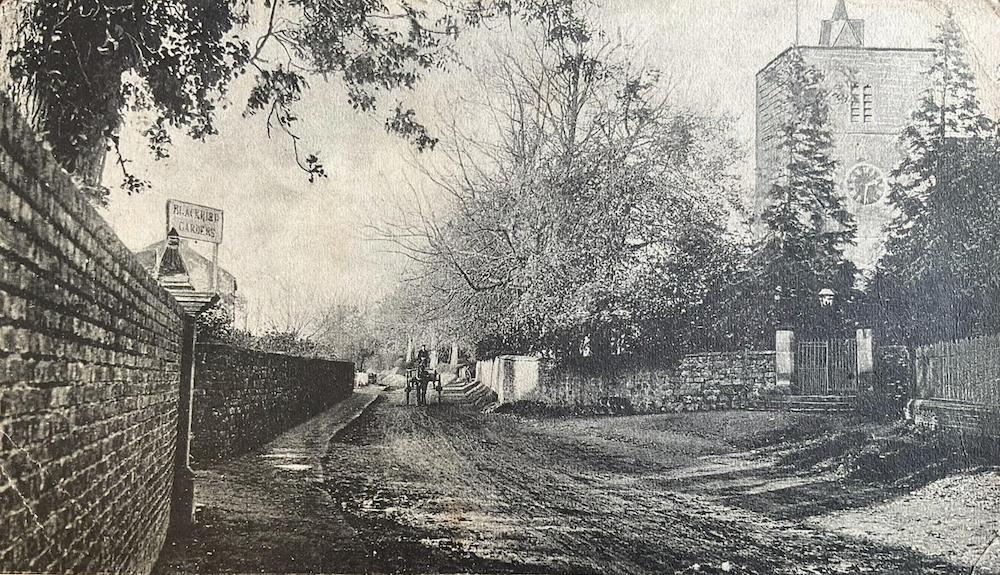
At the beginning of the 20th century, there were market gardens, visible with their large commercial greenhouses, all over Ponteland. Some of these, such as Lane Nurseries, at the start of Callerton Lane, have only recently disappeared but others were more short lived and have barely left any trace. Blackbird Gardens were one such. It looks to have operated around 1900 behind the Blackbird Inn. Today there is hardly any record of it apart from its greenhouses shown on Ordnance Survey Maps and a sign in the background of an archive photograph of North Road.
Blackbird Gardens — audio guide
A normal structure on an Ordnance Survey map is indicated by its outline and light grey shading. A greenhouse by contrast, is shown in outline but with cross-hatching rather than shading to indicate it is made from glass. You can see this in the overlay of the map from 1895 over today’s aerial view which shows three green houses on the site just above the label Ponteland Castle.
Technical changes in the mid 19th century had a major impact on agricultural production in the UK. Cheaper glass, due to mass production, the widespread availability of cast-iron and steel frames and better heating systems using coal-fired boilers and hot water pipes made greenhouses more practical and affordable for commercial growers. This permitted the almost year-round production of fruit, vegetables and flowers, all of which had a ready market for them in nearby Newcastle.
The first record of a market garden between the Blackbird Hotel and the Rectory is in the 1871 census when Scotsman, Alexander Badenoch is recorded as living there with his family and is described as a Market Gardener of 18 acres employing 1 man and 1 woman. In the next census of 1881, the description reads a Market Gardener of 3 acres and a Farmer of 20 acres employing one labourer and one boy. In the next census of 1891, the house is listed as
Gardener’s House still with Alex Badenoch is listed as living there. Mr Badenoch must have been here until the 1900’s as he is regularly reported as judging flower shows up until 1903.
Edwin Smith is registered as living in Gardener’s House with his wife and family in the 1911 census when it was listed as having five rooms. His occupation is listed as Florist and Market Gardener. He is still living there in 1922. It looks as if he also had a stall for his produce in the Grainger Arcade in Newcastle as in a 1938 in a society wedding in Ponteland the flowers are reported to have been supplied by Edwin Smith florist, Grainger Arcade.
It is not clear whether the business was in operation during the Second World War but aerial photographs from 1947 do not show greenhouses but the area is also not derelict whereas photographs taken in 1958 clearly show it as wasteland. By that stage also, Thornhill Road had been driven through where the gardens had stood. When the library which was demolished in 2017, was built in 1964, this occupied what was left of the grounds to the rear of the gardens. This was overgrown by this stage but was still known as the Orchards by local residents as it still held some apple and pear trees. Care was taken to preserve some of these and incorporate them into the grounds surrounding the library and clinic. Unfortunately, these trees which represented the last relic of the sites agricultural past were chopped down to make way for the site’s redevelopment as Hemmingway Court.