Berwick Hill Tileworks, Later a Cottage
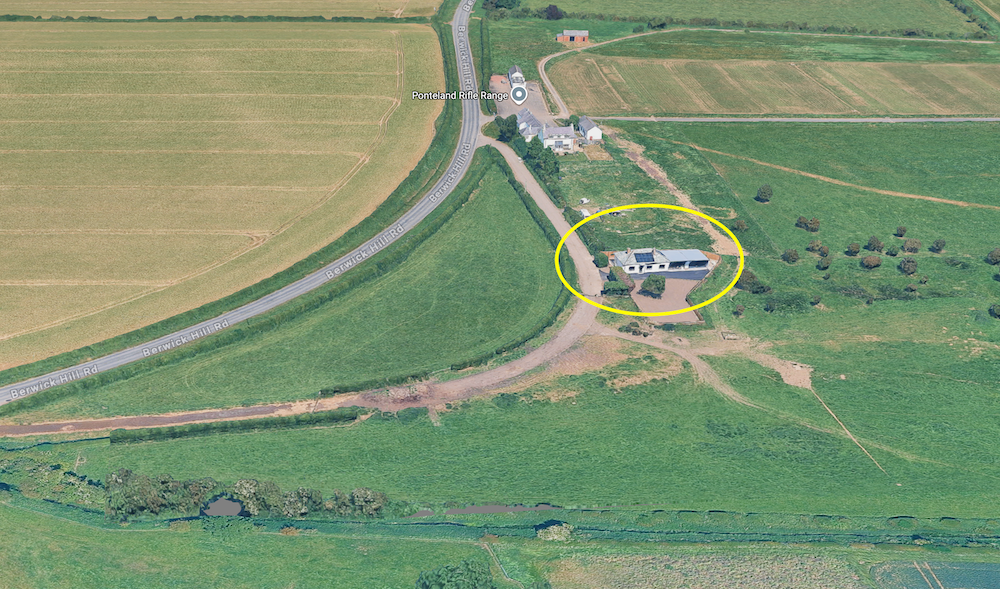
There is a small track just next to the gateway of the Ponteland Rifle Ranges marked Private Road. It leads down to a small, whitewashed cottage. Before the road was straightened, this was the main road. The cottage used to be called Kiln House and is all that remains of one of Ponteland’s early industries.
Berwick Hill Tileworks — audio guide
The Brick and Tile Kiln was established around 1850 around about the same time as another Tile Kiln was built at the western end of the village, off the Belsay Road. Tiles were in demand at this time as it was a period of agricultural improvement when the heavy, waterlogged clays of the district were made more agriculturally productive by digging drainage ditches which were lined with the tiles produced at these kilns to keep them watertight.
The first Tiler listed is William Collinson in the 1851 census. The works seem to have been set up in conjunction with the local landowner, the Stapelton family who also owned the adjacent Park House. Their agent, Edward N. Grace, placed an advertisement in the Newcastle Journal in 1852 offering the tilery for let.
“The TILERY, with COTTAGE SHEDS and other ERECTIONS thereon. There is an excellent Seam of Clay and a large Demand for Pipes and Tiles in the District”.
An 1855 Trade Directory has the works being run by Richard Robinson. A map of 1859 shows the ditches where the clay for firing was extracted and the mills where it was pressed and shaped and the kilns. The house which would later become Kiln House is also shown at the northern end of the site.
In the 1861 census William Bowring is shown living here. He came from Lincolnshire where he had probably gained experience with producing drainage tiles. He later went on to run the Ponteland Tile Works at the other end of the village and ended his life farming West Farm in the centre of the village.
It appears that the Tileworks here went out of business during the 1860’s as they are not listed in the subsequent census of 1871, By 1881 however there is a gamekeeper John Earsdon and his wife living in Kiln House. And in the 1891 census it is named as Keepers Cottage but it did revert back to Park House Tilery in 1901 but still occupied by the John Earsdon. By the time of the Ordnance Survey Map of around 1895, the only trace of the Tileworks are a couple of flooded ponds for the old ditches and some outbuildings but there are some kennels next to the house where the gamekeeper kept his dogs.